When a chair sinks into carpet, scratches a hard floor, or rolls off the edge of a too-small mat, the fix is usually not “buy a thicker mat.” First match the mat’s underside to the floor. Then give the wheels enough surface for the route from the desk to the side drawer and back again.
Pick the back that belongs on the floor
Floortex’s chair-mat guide draws the basic distinction: gripper-back mats are for carpet, while smooth-back mats are for hard floors. Its anti-slip models are for specific polished/high-gloss hard floors, carpet tile, and very-low-pile situations where grippers may not work. Use the exact floor finish and the selected mat’s instructions to settle the last step.
On carpet, measure the pile and include the padding beneath it. On hard flooring, identify the finish before treating a general “hard-floor” label as approval. The Floortex care sheet gives one useful example of why: its Revolutionmat gripper version is for low-pile carpet up to 6 mm including padding; the same sheet says spiked mats are for carpet only and warns that rough tile or uneven concrete can damage smooth mats.
| Surface | Start by comparing | What decides it |
|---|---|---|
| Low-pile carpet | Gripper-back carpet mats | The exact model's pile-and-pad limit. |
| Flat hard floor | Smooth-back hard-floor mats | The product instruction and floor-maker care guidance. |
| Carpet tile or very low pile | A named anti-slip or low-pile model | The surface listed by that product's maker. |
| Grooved or uncertain flooring | Floor guidance before a mat | Whether the product and finish instructions agree. |
Measure where the wheels actually go
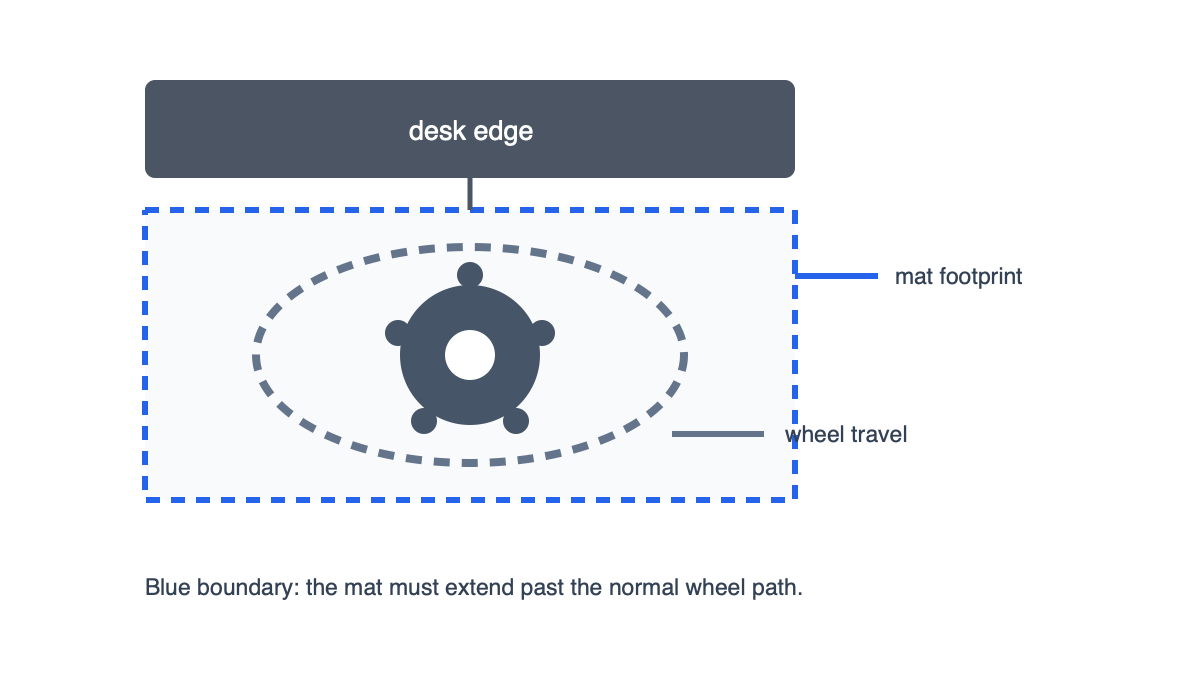
The chair’s resting footprint is too small for most desks. Roll to the side drawer, the place where you stand up, the second surface you reach for, and any route you use to leave the desk. Mark the furthest wheel position in each direction with paper or removable tape, then measure the smallest shape that contains those marks.
That follows Floortex’s size guidance: measure the furthest points the chair rolls. The diagram above shows the practical difference. The chair belongs inside the gray travel loop; the blue boundary is the usable mat area and must extend beyond it. A mat can be large enough beneath the chair while still ending exactly where you need to roll to stand.
Use a paper outline when the desk has a return, cabinet, or angled legs. A lipped mat can give useful forward travel below a straight desk, but only if the lip lands on open floor. A corner or contoured shape can work around a return desk, but not if it narrows the route others use to walk through the room.
Let the room choose the shape
| Workspace pattern | Shape to investigate | The practical check |
|---|---|---|
| Straight desk, mostly forward travel | Rectangle, sometimes with a lip | The lip clears desk legs, thresholds, and feet. |
| Corner desk or side return | Corner or contoured profile | Side travel is covered without blocking the walkway. |
| Compact room | Small rectangle or square | It still covers entering and leaving the chair. |
| Shared circulation route | Smaller compatible shape—or no mat | No edge becomes a new obstacle in the route. |
Compare material after the mat already fits
Once backing and footprint leave a few exact mats, material helps distinguish their practical trade-offs. Clear plastic-like mats keep more of the floor visible; glass and wood/bamboo designs make a more deliberate visual statement; each also brings its own edge treatment, weight, and care instructions. Read those instructions alongside the way the mat reaches the desk and the walking route.
The product care sheet is especially important for a mat shipped folded or with a raised edge. Give it the stated time to lie flat before rolling across it, and choose a shape whose edge is not where you routinely plant a foot. ES ROBBINS’ FAQ explains the category’s purpose—reducing the direct contact between rolling casters and the floor—while the exact product and floor guidance determine whether that approach suits this room.
Lay a paper template in the intended position before ordering. It should cover the chair while you type, the wheel path to your side drawer or second surface, and the space you cross as you stand up. If that template cannot sit flat and clear the walking route, try a different shape rather than forcing a mat into the room. If the real mismatch is the chair’s fit at the desk, start with the ergonomic chair buying guide; if changing from sitting to standing changes the route, use the standing-desk height guide before choosing the final mat footprint.